
Design checkpoint
Start with pressure and clearance
A harder compound can resist extrusion, but it may need more assembly force and may seal less reliably on imperfect surfaces. Capture the pressure direction and maximum gap before choosing a grade.
1. Match hardness to the pressure window
For many static hydraulic applications, 70 Shore A is a useful starting point. Move toward 80 or 90 Shore A as pressure and extrusion risk increase, while checking that the compound still provides enough compliance for surface finish and tolerance stack-up.
Hardness alone does not prevent damage. A correctly sized O-ring, controlled squeeze, compatible lubricant, and a backup ring can deliver a better result than simply moving to the hardest available material.
2. Use squeeze and gap as a design pair
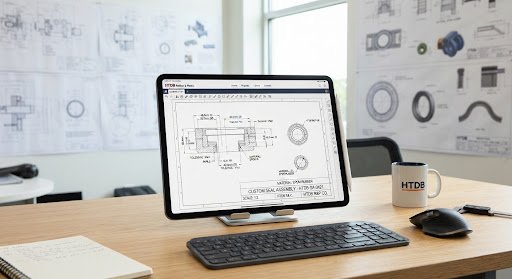
A useful way to review a drawing is to treat squeeze and extrusion gap as a pair. Radial and axial squeeze should be checked against the actual gland dimensions, surface finish, and pressure direction. When the gap cannot be reduced, a backup ring can protect the seal without forcing a compound change.
| Shore A | Typical use | Design note |
|---|---|---|
| 60-70 | Low to medium pressure, forgiving surfaces | Best compliance; check extrusion gap |
| 75-80 | General hydraulic and pneumatic service | Balanced sealing and assembly force |
| 85-90 | High pressure or larger clearance | Consider backup rings and chamfer quality |
3. Validate the gland before release
Before release, confirm gland fill, corner radii, lead-in chamfers, and assembly force. A short prototype run with the production surface finish is often the fastest way to reveal nicks, rolling, or installation damage.
Record the chosen hardness, squeeze, gap, and backup-ring decision on the drawing. That makes future substitutions auditable and avoids a silent change in sealing behavior.
Key takeaways
- Choose hardness with pressure and clearance together
- Use squeeze to manage compliance
- Add backup rings where the gap requires them
- Prototype with production finish and tooling